Before Jazz Had a Name: The Wild, Syncopated Story of Ragtime Music
Before rock shook stadiums. Before jazz transformed improvisation. Before hip-hop rewrote rhythm and culture. Before blues electrified cities.
There was ragtime.
Fast, energetic, unpredictable, elegant, and strangely futuristic for its era, ragtime became one of America's first truly explosive musical movements. It was music that sounded alive. Music that bounced, danced, jumped, and swerved unexpectedly around every corner. In many ways, ragtime felt like rhythm itself discovering new possibilities. Long before modern pop culture understood musical revolutions, ragtime quietly launched one.
And for a generation entering the twentieth century, it sounded like the future.
Ragtime emerged during the late nineteenth century as America itself was rapidly transforming. Railroads expanded. Cities grew. Industry accelerated. Technology changed daily life. Immigration reshaped communities. The country was moving faster than ever before, and music changed alongside it. Out of this atmosphere emerged a style combining African rhythmic traditions with European musical structure. That collision created something entirely new. Structured piano compositions suddenly carried rhythmic energy unlike traditional classical music. The left hand maintained steady patterns while the right hand danced wildly across melodies that seemed almost to resist expectations.
The secret ingredient became syncopation.
Instead of emphasizing beats where listeners expected them, ragtime shifted emphasis into unusual spaces. Notes landed unexpectedly. Rhythms pushed and pulled. Melodies seemed to leap ahead of the beat before snapping back into place. The result felt playful, exciting, and occasionally almost chaotic.
For audiences hearing it during the late 1800s, ragtime sounded radically different.
And some people absolutely hated it.
Others became obsessed.
The genre developed strongest in Midwestern cities and communities including Missouri, particularly around Sedalia and St. Louis. These regions contained active social scenes where musicians performed in dance halls, clubs, saloons, theaters, and gathering spaces. Ragtime flourished within environments where people wanted movement, excitement, and entertainment.
Soon one name began rising above everyone else:
Scott Joplin.
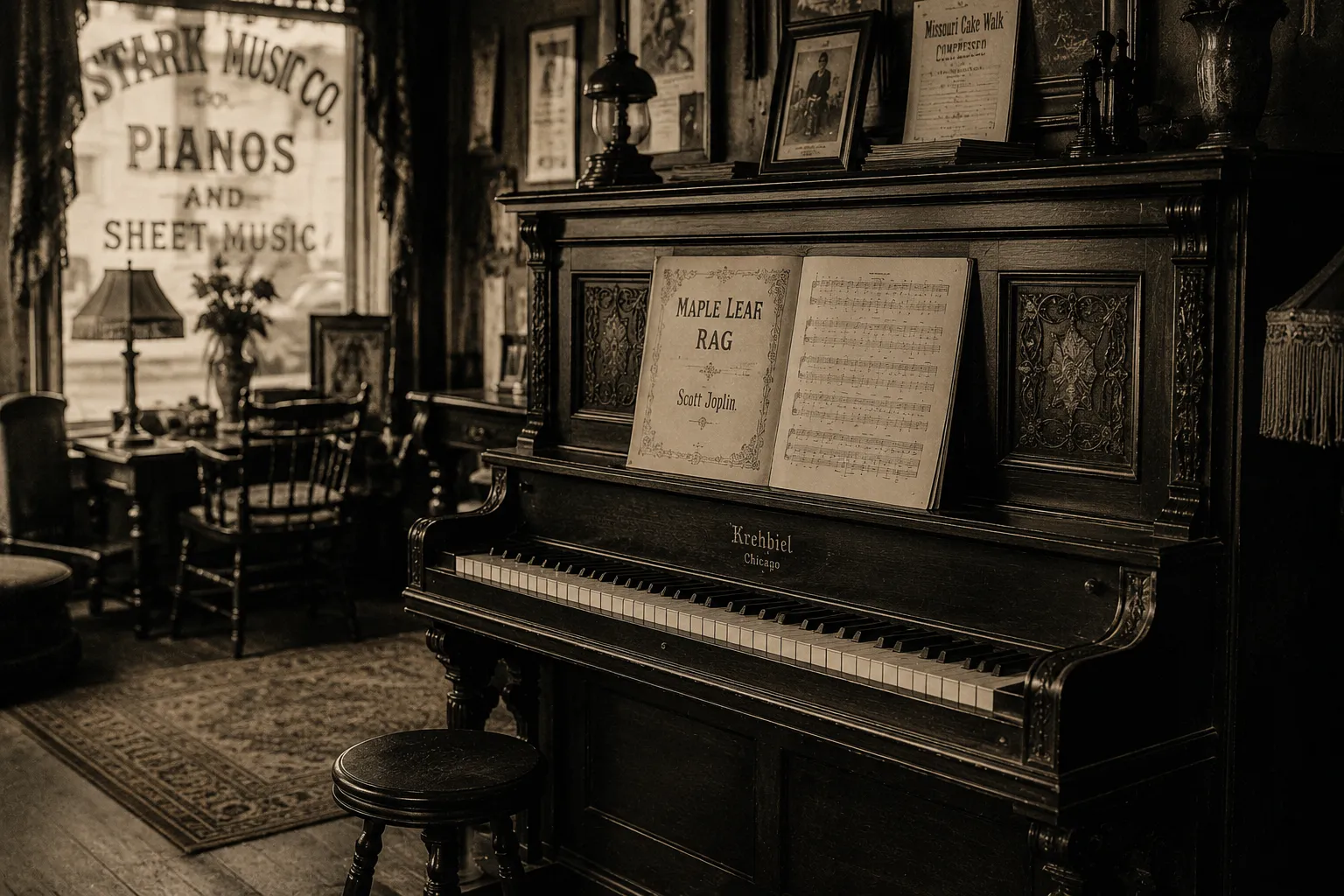
Today Joplin is often called the "King of Ragtime," and not without reason. Few figures shaped an entire musical movement so completely. His compositions transformed ragtime from regional entertainment into a cultural force. Songs like Maple Leaf Rag became enormous successes and spread across America through sheet music.
And that mattered enormously.
Because this was not the radio era.
Not the streaming era.
Not even the record era in any modern sense.
People consumed music differently. Families gathered around pianos inside homes. Sheet music functioned almost like today's digital distribution. If a composition sold well, people played it themselves.
Maple Leaf Rag exploded.
Suddenly ragtime moved everywhere.
Homes.
Dance halls.
Bars.
Parlors.
Theaters.
Street performances.
Piano players across America chased the sound.
And with success came imitation.
Very quickly, publishers flooded markets with new ragtime compositions. The word "rag" itself started appearing everywhere. Musicians created hundreds of variations. Publishers recognized opportunity immediately.
By the early 1900s, ragtime had become one of America's dominant forms of popular music.
But its influence extended far beyond popularity.
Because ragtime quietly changed musical thinking itself.
The genre's rhythmic experimentation laid groundwork for future movements that followed. Jazz musicians absorbed its structures. Blues musicians borrowed from its energy. Early popular music carried pieces of ragtime forward. Even modern genres still reflect ideas introduced during ragtime's rise.
Without ragtime, jazz almost certainly looks different.
Maybe enormously different.
The connection becomes especially visible in early New Orleans music. As musicians combined blues traditions, brass bands, folk influences, church music, and ragtime rhythms, jazz slowly emerged. Ragtime became one of several ingredients helping create one of the most influential musical movements ever born.
Its fingerprints remain everywhere.
Yet ragtime itself eventually faced change.
By the 1910s and 1920s, jazz increasingly captured public attention. Improvisation expanded. Bands grew larger. Musical tastes evolved. Ragtime gradually lost its place at the center of popular culture.
But disappearing from headlines is not the same as disappearing entirely.
Decades later, ragtime experienced unexpected revival periods. Interest returned through films, recordings, and historical rediscovery. One major turning point came when The Sting introduced new audiences to Joplin compositions during the 1970s. Suddenly listeners who had never lived near a piano parlor discovered ragtime all over again.
And they realized something surprising.
The music still felt fresh.
Still energetic.
Still joyful.
Still strangely modern.
Maybe because great rhythm rarely ages.
Today ragtime survives as more than a historical artifact. Musicians continue performing it. Scholars continue studying it. Pianists still chase its technical challenges. And listeners continue discovering how radical these compositions sounded over a century ago.
Because long before America fully understood modern popular music, ragtime arrived and quietly changed everything.
And somewhere beneath every unexpected rhythm, every off-beat groove, and every melody refusing to stay perfectly inside the lines—
a little bit of ragtime still remains.